Government & Policy·Burundi
East African Community Adopts Regional AI Strategy
31 Oct · Africa AI Ledger Desk
Africa AI Ledger · News
The Moroccan agritech company and the UNDP-backed AI Hub will let local startups build country-specific tools on a shared model, with consent, local ownership and open components promised.
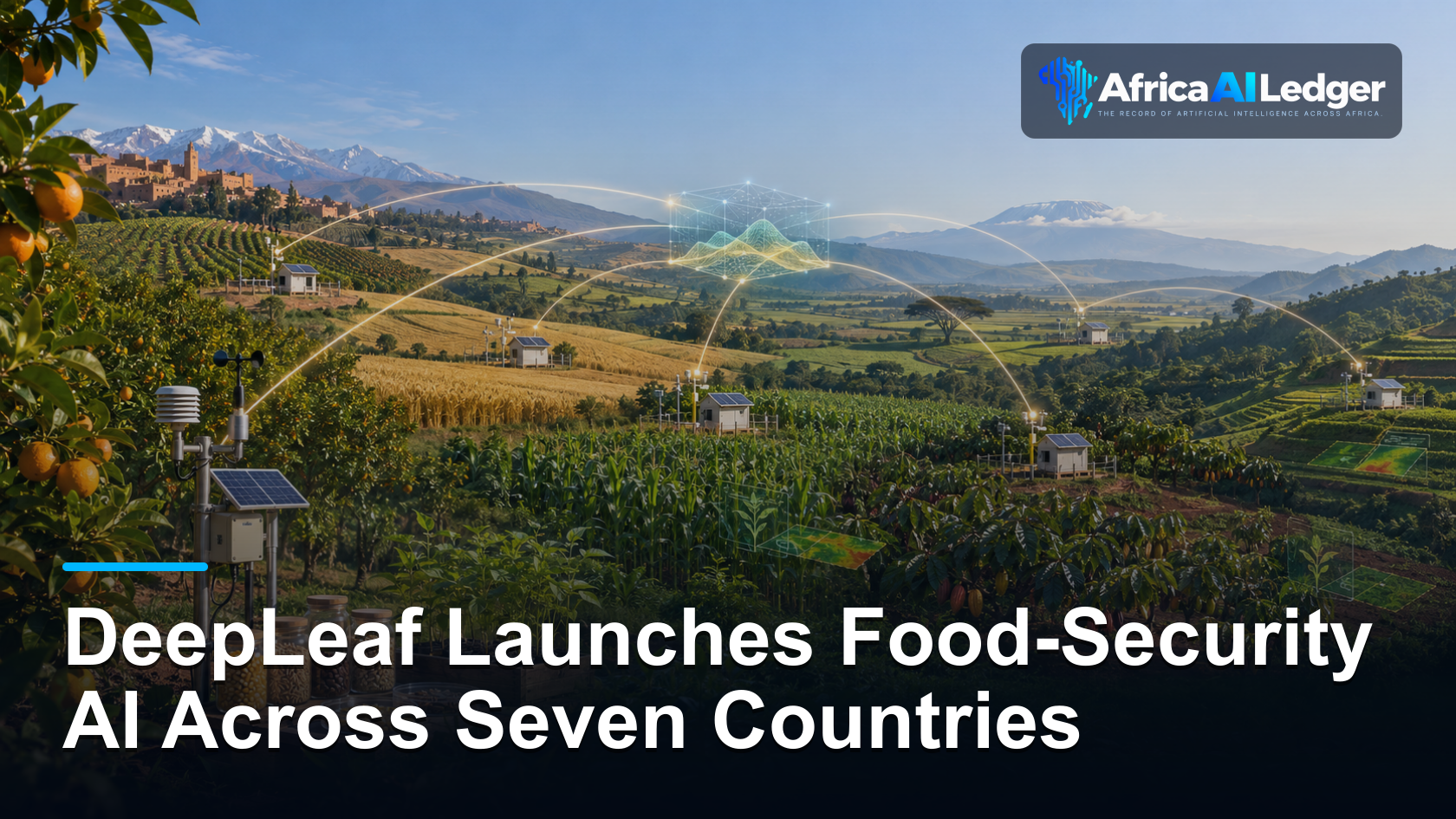
Background generated in ChatGPT; Africa AI Ledger editorial template
Moroccan agritech company DeepLeaf and the AI Hub for Sustainable Development have launched a shared artificial-intelligence model intended to support locally built food-security tools in seven countries.
The programme covers Morocco, Tunisia, Kenya, Ghana, Tanzania, Rwanda and Italy. According to the UNDP Rome Centre announcement, local agritech startups will build their own applications on a common foundation model developed by DeepLeaf and already tested in Kenya, Morocco and Italy.
The partners say data will be shared with consent, resulting solutions will remain locally owned and open components will be returned as digital public goods. Those commitments are important because agricultural AI often depends on farm images, local language, weather information and observations gathered from communities that receive little control over the final product.
The launch does not yet establish that one model will work reliably across seven agricultural systems. Citrus disease in Morocco, maize conditions in Kenya and smallholder production in Rwanda involve different crops, climates, pests and advisory institutions. A shared technical base may reduce development cost, but local teams still need field data, agronomic expertise and authority to reject recommendations that do not fit.
The model should therefore be evaluated country by country. Accuracy on a curated image set is not enough. Useful tests should examine whether advice arrives in time, whether it improves on existing extension services, how performance changes with poor photographs or limited connectivity, and what happens when the system is uncertain.
Local ownership also needs a practical definition. Startups should be able to inspect the relevant model components, adapt them, retain customer relationships and continue operating if the central partnership changes. Farmers and cooperatives need clear rights over data contributed from their fields. Open components are valuable only when documentation, licences and usable technical artefacts are actually published.
The programme's strongest idea is its diffusion model. Instead of building a separate prototype for every country, it tries to create shared infrastructure that local organisations can adapt. This could allow smaller agritech teams to spend more time on delivery, farmer trust and sector knowledge rather than reproducing basic model development.
But shared infrastructure can also concentrate dependence. If all seven ecosystems rely on one external pipeline, a technical error, licensing change or weak crop representation can spread widely. Governance should include local representatives, published version histories and a route for country teams to maintain independent branches.
UNDP says the initiative is moving from partnership toward deployment. The next evidence should include named local implementers, the crops and regions being tested, baseline performance and the open assets promised at launch.
DeepLeaf's programme could become a useful model for African agricultural AI if it combines technical reuse with local control. Its credibility will be earned in fields, through transparent results and farmer participation, rather than through the scale of the launch alone.
Sources: UNDP Rome Centre and The Plain Signal.